{{ n.short }}
{{ n.title }}
{{ n.excerpt }}
{{ n.cat }}
$100,000 held in cash since 2020 now buys
You never saw a withdrawal. The balance never moved. Twenty one thousand six hundred dollars of purchasing power simply stopped existing.
Five year total return through October 2026. Same dollar, same start date, five destinations.
Not a newsletter. Access to allocations, people, and infrastructure that are difficult to reach any other way.
Applications are reviewed individually. Terms are shared directly with approved applicants.
Money is judged on a small number of properties. Here is how each asset scores on all of them.
| Property | Bitcoin | Gold | Edge |
|---|---|---|---|
| {{ g.prop }} | {{ g.btc }} | {{ g.gold }} | {{ g.edge }} |
Gold has a five thousand year record. Bitcoin has sixteen years. That difference is not trivial, and anyone who dismisses it is selling something. Gold has survived every monetary regime, every empire, and every technology shift since the Bronze Age. Bitcoin has survived one credit cycle.
Gold is also genuinely useful. Roughly half of annual demand is jewellery and industrial, which puts a consumption floor under it that bitcoin does not have. And gold does not depend on electricity, internet connectivity, or any functioning network.
For an investor whose primary concern is a multi-generational store that requires no technical competence, gold remains a defensible answer.
Gold's scarcity is relative. Higher prices bring more mining, and annual supply grows between one and two percent. Bitcoin's scarcity is absolute: twenty one million, regardless of price, forever. No amount of demand produces a single additional coin.
Verification is the other decisive gap. Confirming a gold bar is genuine requires assay equipment and expertise. Confirming a bitcoin transaction requires a laptop and seconds. That difference is why gold settlement collapsed into a custodial paper market and bitcoin did not.
Gold solved scarcity and failed at everything else. Bitcoin solved scarcity without giving up anything.
The supply mechanics are covered in what is bitcoin, and the production cost that underpins the floor in the mining guide.
| Company | Ticker | BTC held | Share | Avg cost | Value | Unrealised |
|---|---|---|---|---|---|---|
| {{ r.name }} | {{ r.ticker }} | {{ r.btc }} | {{ r.cost }} | {{ r.value }} | {{ r.pnl }} |
Holdings as last disclosed in public filings. Valued at $68,396 per bitcoin, the spot price as of November 13, 2026.
A corporate treasury exists to preserve purchasing power until the capital is deployed. For most of the postwar period cash did that adequately. Since 2020 it has not: monetary expansion has outpaced deposit yields every year, which turns a cash reserve into a slow, certain loss.
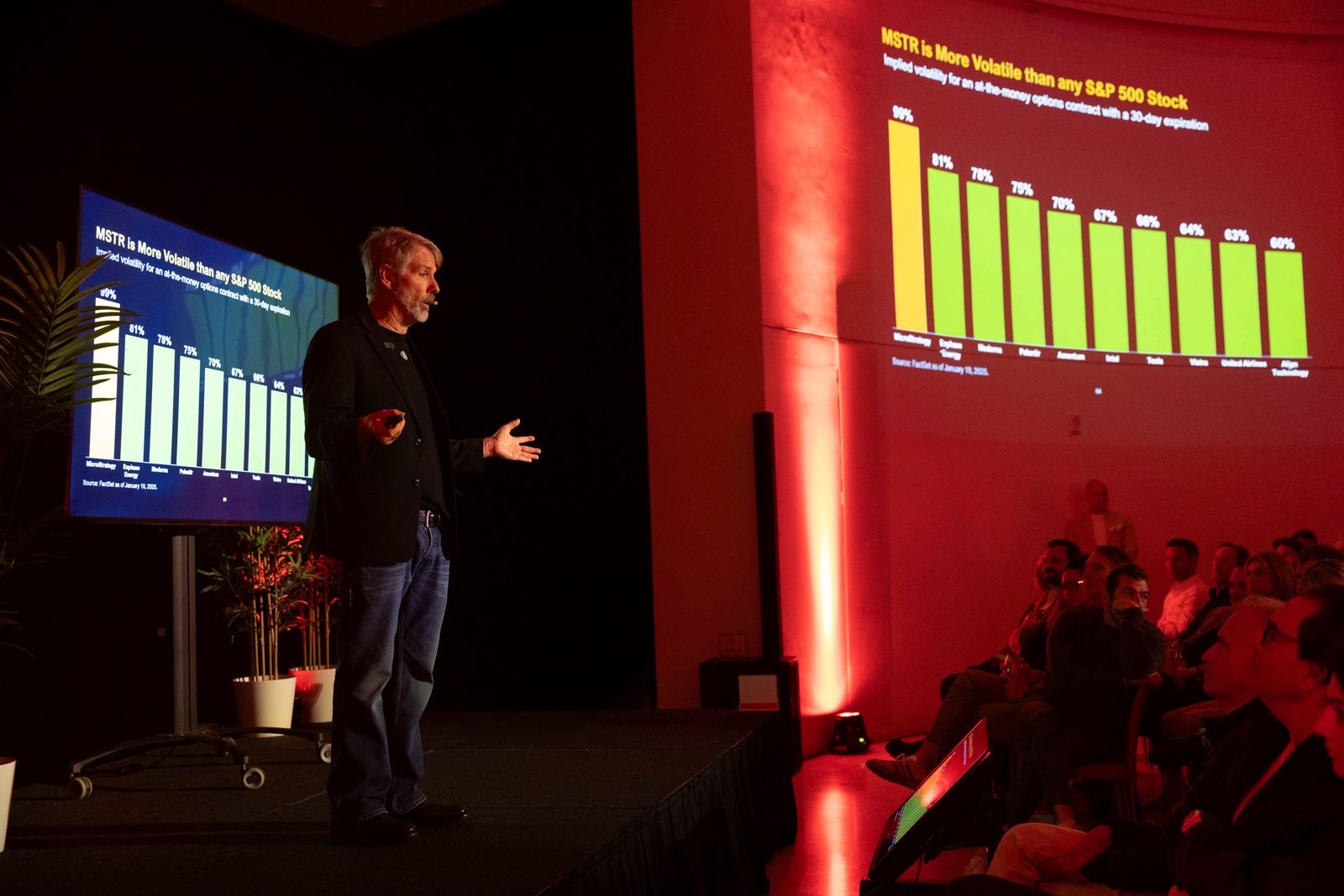
Strategy was first to treat that as a problem requiring action rather than commentary. The decision was criticised as reckless at the time. Six years later the position is worth $58.1B against a cost basis of $64.1B, and the question boards are asked has inverted.
The argument is covered in full in the background on Michael Saylor, and the live position is tracked on the price page.
The same amount, thirteen different starting points. Entry date explains almost all of the variance.
| Year | BTC price | Bitcoin bought | Value today | Return |
|---|---|---|---|---|
| {{ ct.year }} | {{ ct.price }} | {{ ct.btc }} | {{ ct.value }} | {{ ct.ret }} |
Prices are January averages. Past performance does not predict future results, and the drawdowns between these points regularly exceeded fifty percent.
Price on the day, and where it stood one year later. Four events is not a dataset, which is the honest caveat on every chart you will see about this.
| Event | Date | Block | New reward | Price on day | One year later |
|---|---|---|---|---|---|
| {{ h.n }} | {{ h.date }} | {{ h.block }} | {{ h.reward }} | {{ h.price }} | {{ h.after }} |
It halves the rate at which new bitcoin enters circulation. That is the whole mechanism. Everything else said about halvings is interpretation layered on top of one arithmetic fact.
The effect weakens each cycle, and it should. In 2012 the halving removed roughly 2.6 percent of circulating supply per year from new issuance. In 2028 it will remove about 0.4 percent. The supply shock gets structurally smaller as the issued share approaches twenty one million.
What does not weaken is the credibility signal. Every halving that executes on schedule is further evidence that the supply cap is real and that no one can alter it. For an asset whose entire thesis rests on predictable scarcity, that matters more than the issuance arithmetic. The full supply curve is in what is bitcoin, and the effect on miner economics in the mining guide.
A sequence, not a library. Each guide assumes the one before it and builds toward a position you can actually hold.
Most investors who understood the thesis still underperformed the asset. The Club exists to close that gap.
Bitcoin is a monetary network with a mathematically fixed supply of twenty one million units, secured by computation rather than by any institution's promise. That single property is the reason everything else about it matters.
Every currency in history has been issued by an authority that retained the ability to issue more. That ability is useful in a crisis and corrosive over time. US M2 money supply expanded more than forty percent between 2020 and 2024, which means every dollar held through that period purchased meaningfully less at the end of it.
Gold solved this for several thousand years by being physically scarce. It failed at everything else: it is difficult to verify, expensive to move, impossible to divide precisely, and trivially confiscated when held through a custodian.
Bitcoin is the first asset that is absolutely scarce and also perfectly portable, instantly verifiable, and divisible to eight decimal places. It is not a better version of gold. It is a different category.
New bitcoin enters circulation as a reward paid to miners for producing blocks. That reward halves roughly every four years. The arithmetic of a halving sequence converges, and it converges at twenty one million. No committee sets this, and changing it would require near-unanimous agreement from a network with no reason to agree.
Roughly 94 percent of all bitcoin that will ever exist has already been issued. The remainder is released over the next hundred years.
| Halving | Date | Block reward | Annual issuance |
|---|---|---|---|
| {{ h.n }} | {{ h.date }} | {{ h.reward }} | {{ h.issuance }} |
Bitcoin has no administrator. Instead, thousands of independent machines each hold a complete copy of the ledger and reject any transaction that violates the rules. Agreement is reached through proof of work: miners expend real electricity to propose blocks, and the chain with the most accumulated work is the one the network accepts.
This makes rewriting history expensive in a way that scales. To reverse a transaction buried under six blocks, an attacker would need to outspend the entire global mining industry for roughly an hour, and would destroy the value of the asset they were attacking in the process.
The security model is not cryptographic cleverness. It is that attacking the network costs more than it pays.
The mechanics of that cost are covered in detail in the mining guide.
For a decade bitcoin was uninvestable for most institutions, not because of the thesis but because of plumbing. No qualified custodian, no regulatory clarity, no instrument that fit an existing mandate.
Spot ETFs removed all three constraints at once. US spot funds now hold more than 1.3 million BTC, and corporate treasuries hold over a million more. The ETF tracker shows where that demand is concentrated.
What changed was not the argument. It was the ability to act on it.
Next in the sequence: how bitcoin mining works. Or check the live price.
Mining is a competition to guess a number. Machines produce trillions of candidate hashes per second, and whichever finds one below the current target publishes the next block and collects the reward. There is no shortcut, no clever algorithm, only throughput.
The network adjusts the difficulty of that target every 2,016 blocks, roughly two weeks, so that blocks keep arriving about every ten minutes regardless of how much hardware is competing. More machines means harder puzzles, not faster coins.
This is the mechanism that makes issuance predictable. It is also what converts electricity into security, which is the trade the whole system rests on.
Efficiency is measured in joules per terahash. Lower is better, and it is the single number that decides which machines survive a drawdown.
| Machine | Hashrate | Power | Efficiency | Relative | Breakeven |
|---|---|---|---|---|---|
| {{ r.name }} | {{ r.hash }} | {{ r.watts }} | {{ r.eff }} | {{ r.breakeven }} |
Breakeven assumes $0.05 per kWh and current network difficulty. Operators paying more than $0.08 run only the top two rows profitably.
Related: what is bitcoin covers why proof of work exists, and the price page explains how production cost interacts with market price.
Systematic execution across six venues. Signals are generated, sized, and routed without a human deciding whether today feels like the day.
Open the dashboard{{ p.body }}
Backtested against eight years of tick data. Past results do not predict future performance, and every strategy below has had losing years.
| Strategy | Style | CAGR | Max drawdown | Sharpe | Access |
|---|---|---|---|---|---|
| {{ st.name }} | {{ st.style }} | {{ st.cagr }} | {{ st.dd }} | {{ st.sharpe }} | {{ st.access }} |
Members receive the full strategy library, the custom builder, and priority execution routing.
| Series | Level | Change | Why it matters |
|---|---|---|---|
| {{ m.name }} | {{ m.level }} | {{ m.chg }} | {{ m.why }} |
Related reading: the ETF tracker shows where institutional demand is actually landing, what is bitcoin covers the supply mechanics behind the halving, and bitcoin mining explains the cost floor that underpins price.
| Fund | Ticker | AUM | Share | 30d flow | Fee | BTC held |
|---|---|---|---|---|---|---|
| {{ r.fund }} | {{ r.ticker }} | {{ r.aum }} | {{ r.flow }} | {{ r.fee }} | {{ r.btc }} |
Figures as of October 31, 2026. Flows are net creations less redemptions over the trailing thirty sessions.
Related reading: live bitcoin price, the markets hub, and research on institutional allocation.
Coverage of bitcoin, digital asset policy, institutional flows, and the macro conditions that move them.
The first posts from the desk are on their way.
{{ n.excerpt }}
Nothing in this category yet.
Applications are reviewed individually. Terms are shared directly with approved applicants.
Apply for membershipResearch on the bitcoin thesis, corporate treasury strategy, and the macro case for digital capital.
{{ leadArticle.excerpt }}
The first posts from the desk are on their way.
{{ r.excerpt }}
Applications are reviewed individually. Terms are shared directly with approved applicants.
Applications are reviewed individually. Terms are shared directly with approved applicants.
Apply for membership{{ article.standfirst }}
Source:
{{ p }}
{{ sec.quote }}
More on this:
This article is for information only and is not investment advice.
Applications are reviewed individually. Terms are shared directly with approved applicants.
Apply for membershipIn August 2020, Michael Saylor directed his company to convert its cash reserves into bitcoin. At the time the decision was treated as reckless. It is now the most studied treasury strategy in modern corporate finance.
Saylor graduated from MIT with degrees in Aeronautics and Astronautics and in Science, Technology and Society, founding MicroStrategy in 1989 and building it into a leading enterprise analytics platform. For three decades the company was known for business intelligence software. Since 2020 it has been known for something else entirely.
The argument he made was arithmetic rather than ideology. Cash held on a balance sheet loses purchasing power every year that monetary expansion outpaces yield. An asset with a mathematically fixed supply does not. Everything that followed is the consequence of taking that seriously.
{{ t.body }}
The largest corporate holding in the world, and the case study every other treasury now measures itself against.
The thesis is public and has been for years. What is not public is the execution: the positioning, the allocation timing, the private rounds, and the people who are already doing it well.
The Club exists to close that gap for a small number of investors who intend to hold through cycles.
Not a newsletter. Access to allocations, people, and infrastructure that are difficult to reach any other way.
What arrives in a typical week. Published to members before any of it becomes public.
{{ d.body }}
Applications are reviewed individually. Terms are shared directly with approved applicants. No pricing is published.
Our team will review and reach out directly with membership details.
If the fit is right, we will be in touch within two weeks.
{{ p }}
| {{ c }} |
|---|
| {{ cell }} |
{{ sec.closing }}
Research, market data, or membership. Messages are read by the desk, not a queue.
Applying for membership is a separate form, and it asks for more.
Apply for membership →New research and market notes from the desk. We will ask you to confirm your address once before sending anything.
Strictly by application
Applications are reviewed individually. Terms are shared directly with approved applicants. No pricing is published.
Our team will review and reach out directly with membership details.
This page is being rebuilt on the new system.